

What Is My English Grammar Level? Find Out, Then Track It
If you have studied English for a while, you probably already have a rough answer to "what's my level?" — something like "intermediate, I think". That is a fair summary. It just doesn't tell you what to open tonight, or whether the last three months changed anything.
The value of a level test is in what it tells you to work on next. This article explains what the CEFR grammar test on this site measures, how to read your report, and how to build it into a routine of study and practice, so that your next attempt means something.
In a hurry? Take the free CEFR grammar test — about 45 questions — and come back to read your results.
Contents
- What the CEFR test here actually measures
- Why a map beats a score
- Using it as a screening tool
- Challenges: where you practise
- The loop: assess, study, practise, re-test
- Tracking progress over time
- What the test does not tell you
- How to get started
What the CEFR test here actually measures
The test is a grammar-focused level assessment. It is not a general English exam. There is no listening, no speaking, and nothing to write from scratch. Every question targets one grammar point and is labelled with the CEFR band it belongs to.
Questions come from every level, grouped into three bands:
- A1 & A2 — the foundations: basic tenses, articles, word order, simple questions and negatives.
- B1 & B2 — the plateau zone: perfect aspects, conditionals, passive voice, reported speech, relative clauses.
- C1 & C2 — the fine detail: inversion, concessive structures, subtle modality, and choices that depend on formality.
When you finish, you get a report with a percentage bar for each of those three bands, a total, and an overall estimated level from A1 to C2. Questions are matched to levels using published CEFR descriptors. You can browse the level taxonomy itself on the CEFR level tag page.
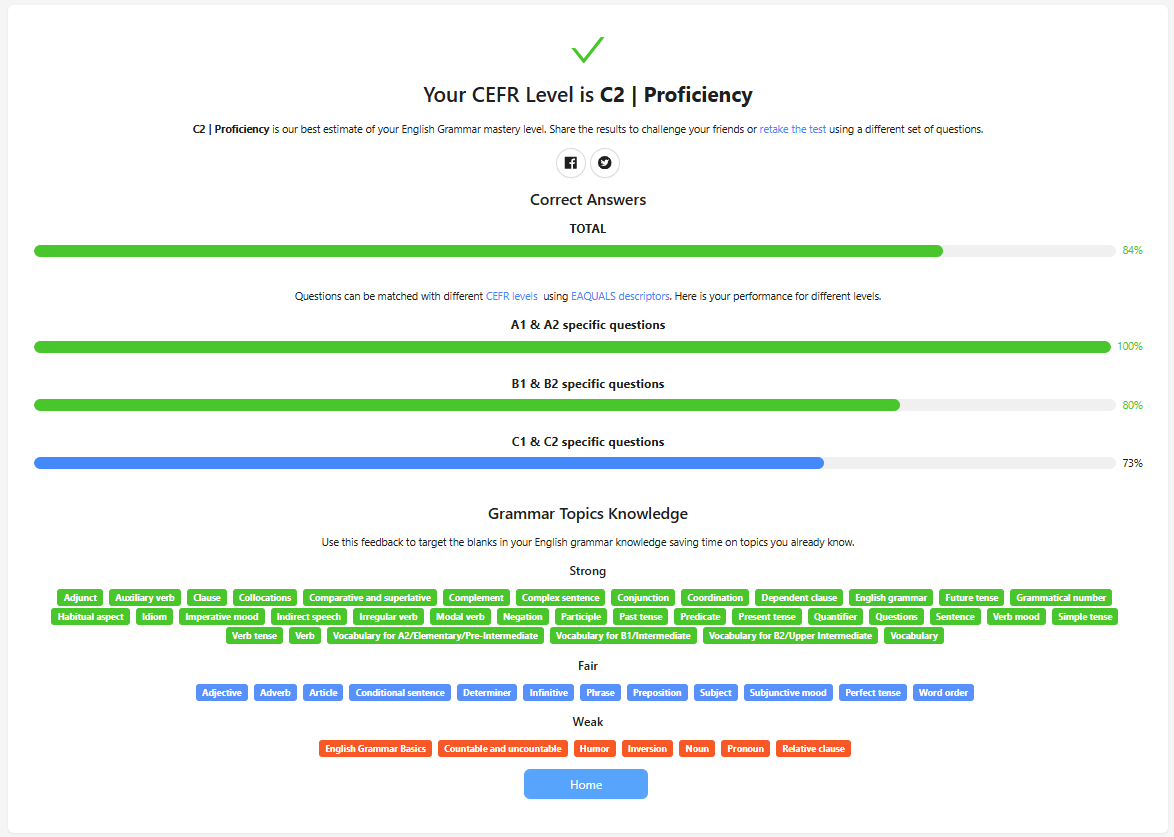
A real report. This learner scores C2 overall — yet "English Grammar Basics", "Countable and uncountable" and "Relative clause" still land in the Weak list.
That is the point of the three-part breakdown. A single overall label hides the shape of your knowledge, and the shape is what you can act on.
Why a map beats a score
Imagine two learners. Both come out as B1.
The first scores 95% on A1/A2, 62% on B1/B2 and 20% on C1/C2. That is a normal, healthy profile: solid foundations, and work to do at the next level up. The advice is simple — keep going up.
The second scores 70% on A1/A2, 65% on B1/B2 and 40% on C1/C2. That is a very different situation. This learner has read and listened a lot and picked up advanced structures by exposure, but the basics have gaps. Moving on to C1 material would skip past those gaps, and they are lower down.
Both are "B1". Only the breakdown tells them apart.
Curious which profile is yours? Take the CEFR grammar test.
The report goes one step further. It sorts the grammar topics you were tested on into Strong, Fair and Weak lists, based on your answers to the questions carrying each tag. Those tag names are clickable, so a weak topic is one click away from the material and exercises for it. This is what turns a result into a to-do list. Instead of "improve your English", you get "articles and conditionals are weak, verb tense is fair, word order is strong".
Using it as a screening tool
Think of the test as a screening, like a quick health check: cheap, fast, and meant to find the things worth a closer look. It takes a few minutes and shows you blind spots. Left unchecked, those blind spots can absorb a lot of study time.
It is especially worth doing:
- Before exam preparation. Grammar accuracy is part of the writing and speaking scores in exams like IELTS. Knowing which structures are shaky lets you spend prep time where the marks are, instead of repeating general practice tests. (Our IELTS format guide covers those criteria.)
- Before starting a course or a textbook. Courses are built for an average student. The test tells you which chapters you can skim and which ones deserve real attention.
- When you have plateaued. You understand almost everything you read and you can hold a conversation, yet your writing keeps coming back with corrections. A plateau often turns out to be a small set of specific structures that never got fixed, rather than a general problem — and the Weak list is where those show up.
Challenges: where you practise
Knowing where the gaps are is half of it. Practice on this site lives in the challenges collection: topic-focused question sets where every question comes with an explanation of the rule behind the answer.
Challenges are filtered by grammar tag, using the same taxonomy the test reports against. If the test flagged articles as weak, go to the articles challenges. If it was tenses, go to the verb tense challenges. The tag names in your report link straight through, so you don't have to hunt for the right material.
Each completed challenge produces a report of its own, topic by topic. That gives you much faster feedback than a test every few months. A challenge tells you whether tonight's practice worked. The level test tells you whether the last two months moved your position.
The loop: assess, study, practise, re-test
Here is the cycle the whole thing is built around.
- Assess. Take the CEFR test. Note the three band percentages and the Weak topic list, or just keep the report open.
- Study the theory. Pick one or two weak topics rather than a long list. Read the rule, read the explanations attached to the questions you got wrong, and make sure you understand why the right answer is right.
- Practise. Work through challenges tagged with those topics until those topics stop coming back as weak. Repetition is what moves a rule from "I understand it" to "I use it without thinking".
- Re-test to benchmark. Come back and take the level test again.
Re-testing only works if you cannot memorise the test, and you cannot: each attempt pulls a different set of questions from the pool. A second attempt measures your grammar, not your memory of last time's answers.
Between attempts, don't compare the headline level. It is a rough label, and it can stay the same for months while real improvement happens underneath. Compare the three bars instead.
A B1/B2 band moving from 58% to 74% is clear progress, even if the overall label still reads B1. When the band you are working on climbs while the band below it stays high, that is the clearest sign your study is working.
Don't re-test too often. Give the loop time to work — a few weeks of real practice, not a few days.
Tracking progress over time
If you create an account, your results are saved. Your profile then holds:
- A CEFR level tests section listing every saved test: the level achieved, the date, the correct/total count, and the same A1/A2 · B1/B2 · C1/C2 breakdown as the full report. Each entry links back to its complete report, so you can compare two attempts side by side instead of relying on memory.
- A Progress section showing grammar mastery by topic, built from everything you have answered across challenges, organised by grammar area with the weakest first.
Without an account you still see your full report for that session, but it isn't saved and it won't be there to compare against next time. If you plan to use the test as a benchmark rather than a one-off check, it is worth registering before your first attempt.
What the test does not tell you
Knowing the limits is what makes the result trustworthy.
- It measures grammar, not English. There is no assessment of speaking, listening, or extended writing. You can score well here and still struggle in a fast conversation. Those are different skills and they need different practice.
- It is an estimate, not a certificate. The level is our best estimate of your grammar mastery, based on the questions you answered. It is not an official CEFR certificate, and no institution will accept it as one. For that you need a recognised exam.
- One test is a snapshot. Tiredness, a noisy room, or an unlucky draw of topics all move the number a little. One result is a rough position. Three results over three months are a trend, and the trend is what matters.
With those limits in mind, the test does one job well: it tells you what to work on next.
How to get started
- Create an account so your results are saved and you can compare them later.
- Take the CEFR grammar test without preparing for it. You want an honest baseline, not a good-looking one.
- Read the report properly: the three band bars first, then the Strong / Fair / Weak topic lists.
- Pick one or two weak topics and work through the matching challenges. Read the explanations instead of chasing the score.
- After a few weeks of real practice, retake the test and compare the bars in your profile.
- Repeat with the next weakest topic.