

How to Track Your English Grammar Progress
Eight out of twelve tells you how the last ten minutes went. It doesn't tell you which eight, or what they had in common.
This article covers what happens after you finish a challenge here — the per-topic report, the answer explanations, and the Progress map on your profile that updates as you go.
Ready to start? Pick a challenge and come back to read your report.
Contents
- The report you get immediately
- Explanations, not just the right answer
- Your Progress map
- Reading the map
- The loop
- Scenarios
- Start tracking
The report you get immediately
Finish a challenge and you get more than a score. Every question carries grammar tags, so your answers sort themselves by topic straight away.
The report opens with Needs work — the topics you got wrong most often in that attempt, weakest first, each linking to more practice on that topic. Below it, every topic the challenge touched, with your hit rate. A ten-question challenge can cover a dozen topics, and the mix is usually uneven: word order fine, articles shaky, conditionals wrong twice out of two.
That is the difference between "8/12" and "articles and conditionals let you down". One is a grade. The other is a plan for tomorrow.
Explanations, not just the right answer
Every question here comes with a written explanation of why the right answer is right — not just a green tick.
You can read them straight after the attempt, or open a challenge's correct-answers page later without redoing it — for example, Basics. Word Order. They are ordinary pages, so you can bookmark one and come back to a rule that keeps catching you.
This matters because a wrong answer has two possible causes. Either you didn't know the rule, or you knew it and misapplied it under time pressure. Those need different responses — study versus repetition — and the explanation is what tells you which one you are dealing with.
Your Progress map
A single report covers a single attempt. The Progress section on your profile is the accumulated version: every answer you have given, organised by grammar area, weakest first.
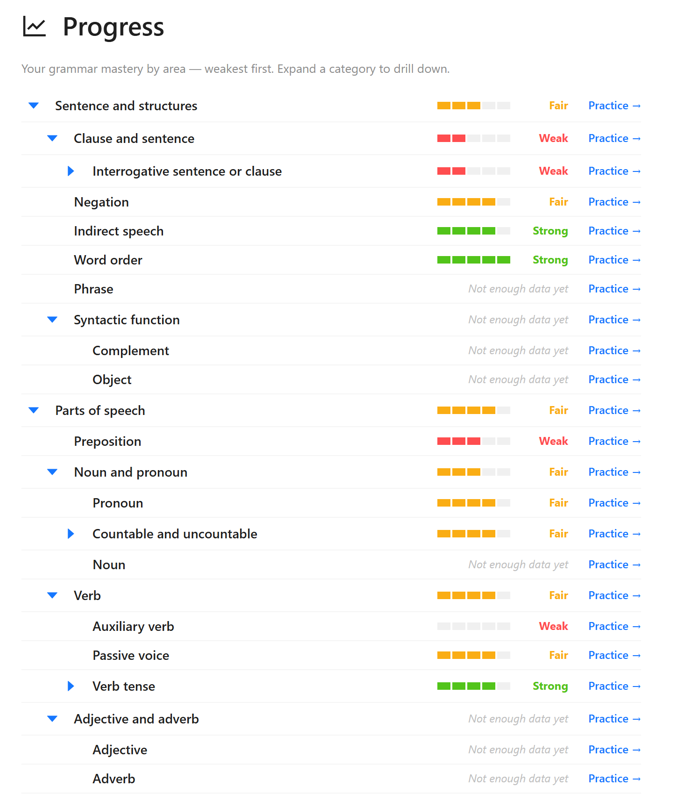
Weak, Fair and Strong, with the weakest areas listed first.
It is a tree, not a flat list. Parts of speech rolls up everything beneath it — nouns, verbs, adjectives — so you can read the top level in seconds and expand only where something looks wrong. Every row links to practice for that topic.
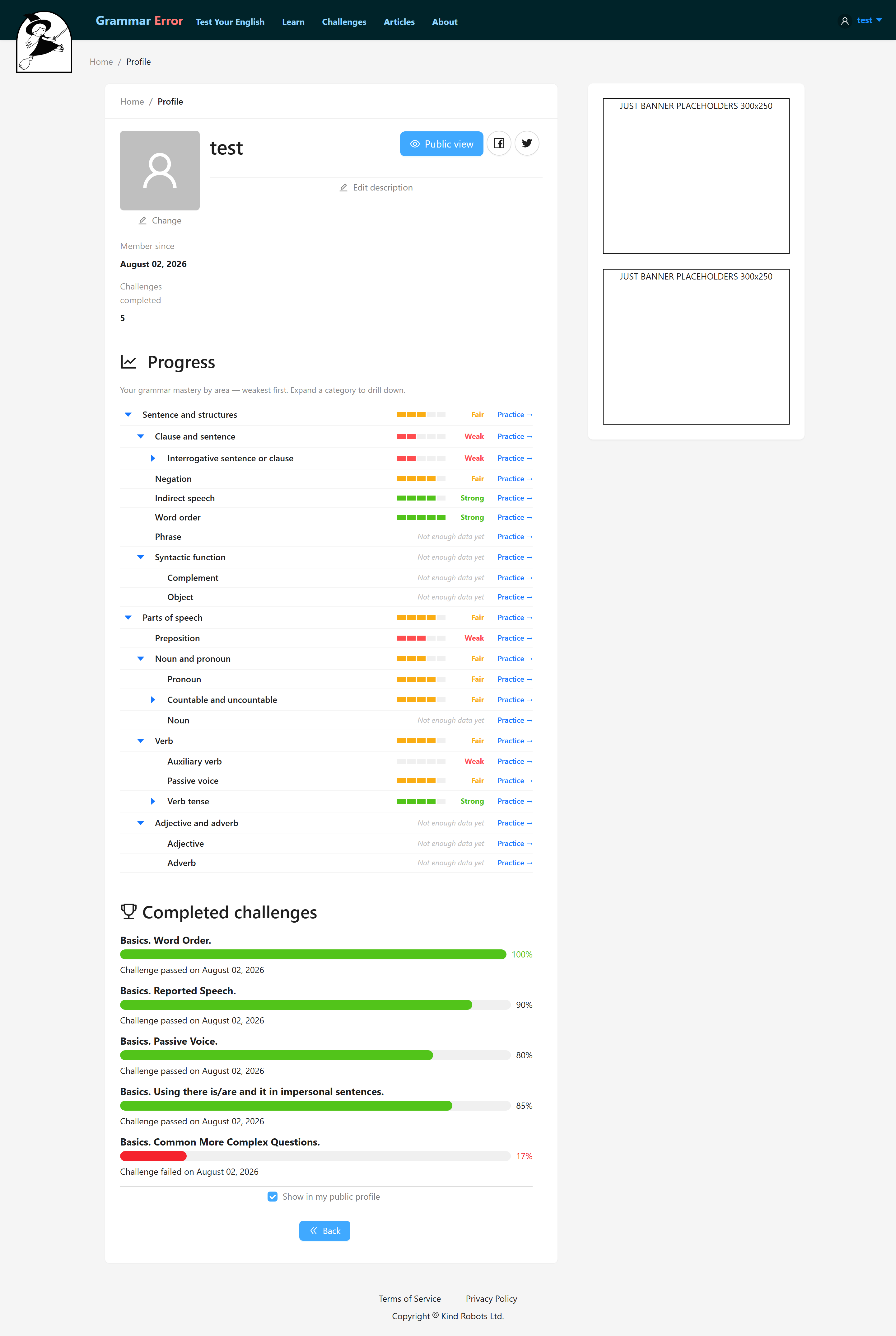
The section sits above your completed challenges, so one page shows both the trend and the individual attempts behind it.
Reading the map
Three things are worth knowing so you read it correctly.
- "Not enough data yet" is not a zero. A topic needs a handful of answers before any claim about it is worth making, so those rows fill in as you practise. A topic you have never touched stays blank too — worth noticing, because it is often the one you have been avoiding.
- It follows your recent work, not your entire history — the last ten challenges and your last two level tests. Something you fixed six months ago stops dragging the number down, and something you have started getting wrong shows up quickly.
- A parent row is a summary. If a category reads Fair, that can mean everything under it is middling, or that one child is Strong and another is Weak. Expand it before deciding what to do.
The loop
- Take a challenge. Ten minutes is enough.
- Read the report. Note the Needs work topics.
- Read the explanations for what you got wrong — especially where you were confident and still wrong.
- Check your profile. The map has already moved.
- Practise the weakest row using its Practice link, then repeat.
The point of step 4 is not the number — it is the timing. The map updates while the questions are still fresh. Check it a month later and you are guessing at what went wrong.
Scenarios
Studying on your own. Open your profile, take the top Weak row, practise it, and stop. Deciding what to study is often the part that stalls, and the map removes it.
Preparing for an exam. Grammar accuracy carries marks in the writing and speaking sections of exams like IELTS. Generic practice tests won't tell you which structures cost you those marks — the Weak list will. (See our IELTS format guide for how those criteria work.)
Coming back after a break. Do two or three challenges across different areas. Because the map follows recent work, it re-reads your current level rather than the one you had when you stopped.
Working with a teacher. The Weak list is a concrete answer to "what should we look at?" and saves lesson time otherwise spent finding out.
Just keeping the habit. Ten minutes, one challenge, one row of the map. Watching Weak turn to Fair is a better reason to return tomorrow than a streak counter.
Start tracking
Create an account so your results are saved, then take any challenge — your map starts building from the first one, and every attempt after it sharpens the picture.
If you would rather begin with a broad baseline, take the CEFR level test first. What a level test tells you explains how the two fit together.